بروزرسانی: 25 آذر 1404
SEO-SEM Collaboration | TechnicalSEO.com
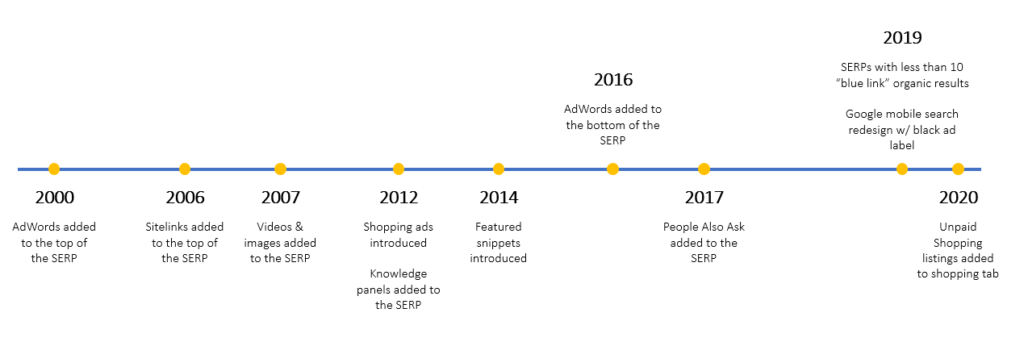
Since 2000, search engine optimization (SEO) and search engine marketing (SEM) have played in the same space. Countless ad formats and rich result types have been added to the search engine results page (SERP), creating a more visual and competitive landscape.
Feed management is a sub-specialty that many SEM teams help run, given that 89 percent of non-brand Google paid search clicks now come from feed-powered Shopping ads, according to the Merkle Q1 2020 Digital Marketing Report. Until recently, there was little focus on it from SEOs, since most SEO work is focused on crawling, indexation, and ranking. With the Google announcement of Unpaid Shopping Listings under the shopping tab, both teams are given an opportunity collaborate by:
- Ensuring the product feed adheres to GoogleMerchant Center best practices.
- Buildingreporting dashboards for Organic Shopping Listings that incorporate sessions,revenue, and other relevant organic metrics.
- Working together to further optimize thefeed with title updates, image testing, description changes, and google productcategorization improvements.
Crawling and Navigation
Like transactional queries, a strong SEO strategy forinformational queries relies on targeting rich SERP features. To achieve theseplacements, SEOs should consider using the following techniques:
- Conduct advanced keyword analysis and landscape research to understand core user questions.
- Audit a site’s existing content to understand which pages can be optimized to answer informational queries and to identify gaps where new content needs to be created.
- Structure content to align with the SERP feature being targeted.
- Use structured data to make the content easily digestible for search engines.
- Leverage image and video content to create a rich user experience and ensure SEO best practices are followed.
Even for those who are only able to work formally within a siloedSEM or SEO team, curiosity about other channels will still yield benefits.There may be some limitations on your ability to apply the techniques mentionedhere. However, the practice of asking user-centered questions that consider theholistic search journey will position you to notice and articulate whereopportunities exist across all channels.
منبع: https://technicalseo.com/insights/blog/seo-sem-collaboration/
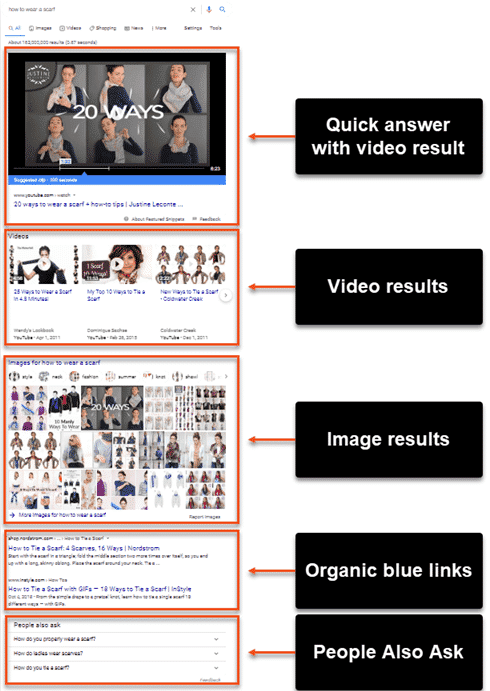
Informational search queries are designed to answer an explicit or implied question asked by the searcher. SERPs for these queries tend to be characterized by prominent rich results that include quick answers or video content, news carousels, People Also Ask listings, and organic blue links. Some informational query SERPs will include paid listings. The example below for the query “how to tie a scarf” highlights several such SERP features:
Informational Queries & SEM Strategy:
As the search landscape continues to become more competitive, utilizing organic and paid placements leads to more visibility and more opportunities for searchers to interact with your website. Integrated teams must balance the ROI required to achieve these SERP placements and identify opportunities that benefit the brand’s goals. Shared query reporting and holistic overall search ROI can be compiled and reviewed across teams to identify areas of further opportunity within either channel.
Informational Searcher Intent
Informational Queries & SEO Strategy:
Integrated teams can leverage various skillsets to benefit other channels with which they work. Specifically, teams can jointly contribute to projects related to messaging, on-page content / searcher intent, user experience, and optimizing SEO and SEM channels from a technical perspective.
Content & Messaging: Use Holistic Team Insights to Understand & Optimize for Search Intent
Holistic Search Strategy for Targeting Transactional Queries
Engines are looking for users to want to click through on ads and have a good experience. If an advertiser has a higher landing page experience (i.e., it is relevant for the searcher and the query), then the quality score of that ad will be higher and contribute to cost-per-click (CPC) savings compared to competitors. In SEO, ranking relevancy is determined by having a useful on-site experience, clearly relevant to the original query. Similarly, regular search query monitoring and negative query additions are important in SEM. They block irrelevant traffic from matching against ads, which both increases the conversion rate of traffic that does get through to site and helps to rank higher in auctions via increased quality score, without increasing bids.
SEM has evolved a lot over the years, from historically onlygoing after terms that drive the best last-click ROI to now seeing the value inbeing present on less conversion-focused queries for the purpose of filling thefunnel. In a world with many different attribution models available, we now havemore flexibility to distribute conversion credit to informational queries when aportion of that traffic comes back and converts via another interaction. Forthis, we recommend one of the following attribution models:
- Data-driven attribution
- Time decay
- Linear
For these types of queries, traffic is best matched to long-form content (typically blog) pages built out by SEO teams. Within SEM, this traffic is best acquired via running either text ads, which target keyword-matched queries to chosen landing pages, or Dynamic Search Ads (DSAs), which target relevant queries to designated types of landing pages. For SEM, the agreed upon goals of this traffic and the volume of traffic coming through these terms will help determine which ad format is best for running support. For clients just starting out in advertising on informational queries, we recommend starting with DSA targeting on a smaller budget and an automated bid strategy focused on driving traffic. From there, begin breaking out either more granular DSA targets or stand-alone text ads for high-volume terms, as well as testing into more conversion-focused bid strategies.
From an SEO perspective, crawling and navigation are keyconsiderations that impact page discovery for crawlers. Alternately, SEMresults are based on a bid, but also on the relevancy and expected CTR of thatproduct or group of products in context of both the user’s query and what thesearch engine knows about that user and his or her online behavior.
In an integrated environment, SEM and SEO teams can collaborate, learn from each other, and provide incremental benefits, which include:
- Keeping one another informed of quickly changing business plans and respond with urgency.
- Ensuring consistent messaging in the SERP, contributing to a seamless user experience for customers.
- Uncovering patterns, anomalies, and opportunities that are more difficult for a single channel team to identify on their own. By having a larger team working regularly with a website, the collective knowledge of the business grows, offering greater fluency for understanding requests, and anticipating business needs.
Transactional Queries & SEM Strategy:
As with cross-channel collaboration of any kind, the goal isto create a seamless experience for consumers, no matter how they’reinteracting with your brand. Outside of the above examples, have SEM and SEOteams meet regularly to discuss what they’re working on and their channel goals.This will result in interesting collaborations. It will help search teams tospeak one another’s language and recognize situations where one opinion orperspective could create additional value for another business or businesspartner.
When given similar bids, the SEM team can see whatindividual products the search engines see as winners on the SERP and whatproducts will stand out against the competition, get traffic onto the client’ssite, and drive conversions. As a pull marketing channel, product traffic andsales trends are typically very reflective of seasonal demands across theentire product catalog. Using SEM data to our advantage, we can look at product-levelreporting and see what products over index in sales via SEM compared to non-SEMall-site sales. Narrowing to the top outlier products reveals interestingimplications to begin answering broader questions, such as: “Which productsshould we pin to show at the top of a category page?” “What products would bewinners, in that they had more visibility?” “Which products should be moved toclearance, given that they convert poorly even with a lot of highly relevanttraffic?” In these instances, SEM product performance can help us make moreinformed assumptions about what appeals to a business’s user base on-site and acrosschannels.
For many brands, it can be difficult to justify the SEM expense of targeting informational queries, as it is typically a higher funnel strategy or branding play. However, by leveraging SEM data, SEO can use paid insights to understand where there is more ROI to be had for informational content. This creates a win-win situation for the brand, which can more easily justify the expense of creating the content.
Use Cases: Technical SEO + Technical SEM
Organic Merchant Center Programs
Holistic Search Strategy for Targeting Informational Queries
Transactional Queries & SEO Strategy:
Staying siloed in either an SEO or SEM context can feelcomfortable for those who have never worked in integrated search. Whilestepping outside of established routines to try new cross-channel techniquesmay feel intimidating, communication is the essential first step to creating amore collaborative strategy.
Most retail SEM programs heavily weigh ad support towardtransactional queries, as they often have a stronger return on investment(ROI). Besides the keyword/target bid, search engines weigh an ad’s qualityscore to determine rank. Quality score is an aggregated view of how well the adexperience matches the users’ queries. Quality score is composed of:
- Expected click-through rate (CTR)
- Ad relevance to the query
- Landing page experience
Searcher intent typically falls into one of two categories. The first category is transactional, where searchers are looking to purchase an item. The second category is informational, where searchers are looking to learn something. Both scenarios have different outcomes and require each team to adjust its content and messaging strategy to meet user needs and best utilize SERP features.
Transactional Searcher Intent
Using SEO & SEM to Create a Seamless User Experience
Informational queries are an opportunity for SEO to drivenon-branded traffic, increase awareness, and build authority. Depending on thevertical, content that answers informational queries can be an importantsupplement to a business’s products and services, or it can be the productitself. Retailers most often use long form writing, multimedia assets, andinteractive features to enhance a customer’s purchase journey and distinguishthemselves from competitor pages on the web. News publishers, nonprofitorganizations, financial service providers, and education sector websites, dependheavily on content that can answer user questions in order to maintainrelevance and drive engagement.
Leveraging SEM data against SEO data can also lead us to discover orphaned PDPs and categories that can be difficult to find. To help identify them more quickly, we can run an analysis of what is over-indexing in sales via SEM and cross reference those products or categories to the user’s on-site, navigational experience finding them. This is a quick and clever way to ensure products that might be under-performing outside of SEM can be optimized to have a chance at better performance on-site and in organic search.
SEM, SEO, and the User Experience
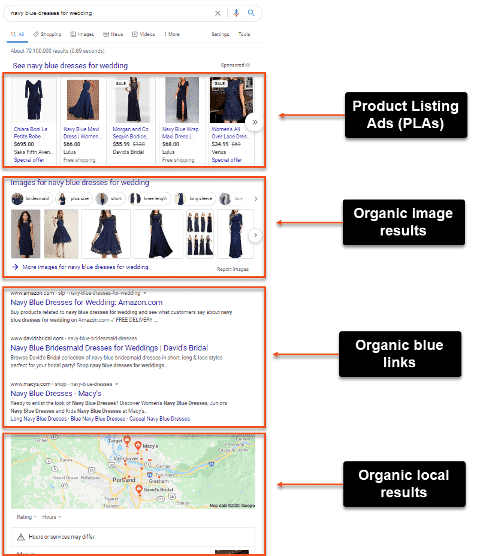
A successful SEO strategy for transactional queries reliesheavily on using rich result SERP features and focusing on the following bestpractices:
- Make the site easy to navigate with a crawlableand intuitive taxonomy and strong internal linking signals.
- Havecategory or product listing pages, which provide an efficient user experience, withtargeted meta data, a variety of product listings, and strong on-page content.
- Ensureproduct detail pages have thorough product descriptions, images with optimizedalt text and file names, error-free structured data, and relevant productattributes listed.
- Leveragerich result opportunities by ensuring Google My Business listings are complete,video listings include detailed transcripts and video descriptions, etc.